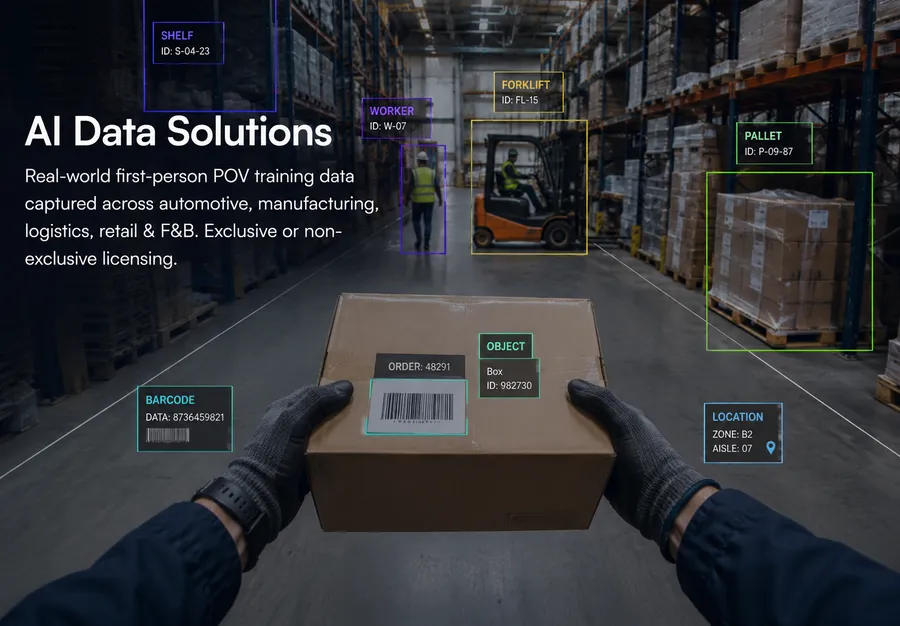

First-person POV data is egocentric video captured from the viewpoint of the person performing a task. It preserves natural hand motion, gaze direction, body movement, and environmental context, making it useful for computer vision, robotics, and embodied AI systems that must understand real human activity.
Outside-in video and egocentric video show different evidence
Most training video is shot from the outside looking in: a fixed camera watches a scene unfold. First-person POV data is shot from the inside looking out. The camera moves with the person doing the task, so the model sees the task at the height, angle, and motion of a real participant.
Real capture retains the difficult moments
The distinction matters most in moments that are hard to stage: a driver's micro-adjustment at a blind intersection, a warehouse worker changing grip on an awkward package, or a line cook checking multiple surfaces before plating. Real capture retains hesitation, retries, and workarounds because real deployment contains them too.
Annotations turn footage into model-ready evidence
Depending on the project and license, first-person footage can be paired with timestamp-aligned pose, hand-mesh, gaze, depth, detection, action, and sensor annotations. The value is not only the video; it is the synchronized ground truth that describes what the participant and environment were doing in each frame.
Frequently asked questions
What is first-person POV training data?
It is video and sensor data captured from the viewpoint of a person performing a real task, often called egocentric data. It can include synchronized labels such as pose, gaze, hand movement, depth, and actions.
When is egocentric data more useful than fixed-camera footage?
It is especially useful when a model must understand human attention, hand-object interaction, navigation, or the sequence of actions seen by the person doing the work.