
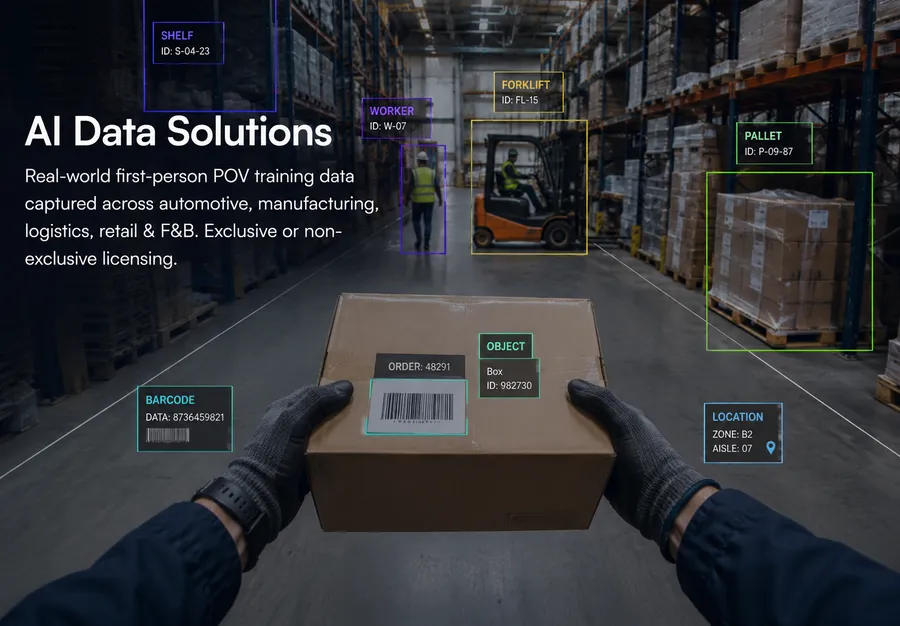

Exclusive AI data licensing restricts a defined dataset to one licensee, while non-exclusive licensing allows the same dataset to be licensed to multiple customers. Exclusive access suits differentiated or proprietary use cases; non-exclusive access is typically better for faster benchmarking and baseline model development.
What an exclusive dataset license means
An exclusive license means a defined dataset is licensed to one company under the agreed scope. It is appropriate when the capture covers a distinctive manipulation task, niche industry, or environment that contributes directly to a model's competitive differentiation.
What a non-exclusive dataset license means
A non-exclusive license allows the same defined dataset to be licensed to more than one company. It is suited to benchmarking, baseline training, research, and cases where reliable ground truth and faster availability matter more than sole access.
A license is not the same as buying copyright
Neither model automatically transfers copyright in the underlying footage. The customer receives the usage rights described in the agreement. The permitted models, teams, territories, duration, redistribution rules, and derivative outputs should be made explicit before delivery.
Frequently asked questions
Should an AI team choose exclusive or non-exclusive training data?
Choose exclusive data when sole access materially protects a differentiated model capability. Choose non-exclusive data when speed, benchmarking, breadth, and lower acquisition cost matter more than exclusivity.
Does an AI data license transfer copyright?
Not automatically. A data license grants the specific usage rights written in the agreement. Copyright ownership and permitted use should be treated as separate contract terms.