Today we ship one thing: consent-verified real-world AI training data, captured to specification. This page is what we are building toward, and exactly how far each program has actually gone.
Shipping today. You can license it, and the proof is on this site.
Prototype
A working artifact exists. It is not a product and is not for sale.
Research
An open question we are actively testing. No product, no timeline.
Exploring
A direction we are thinking about. Nothing is built yet.
[ 01 ]Thesis
Physical intelligence is limited by real-world data, not by ambition.
01
Capture reality
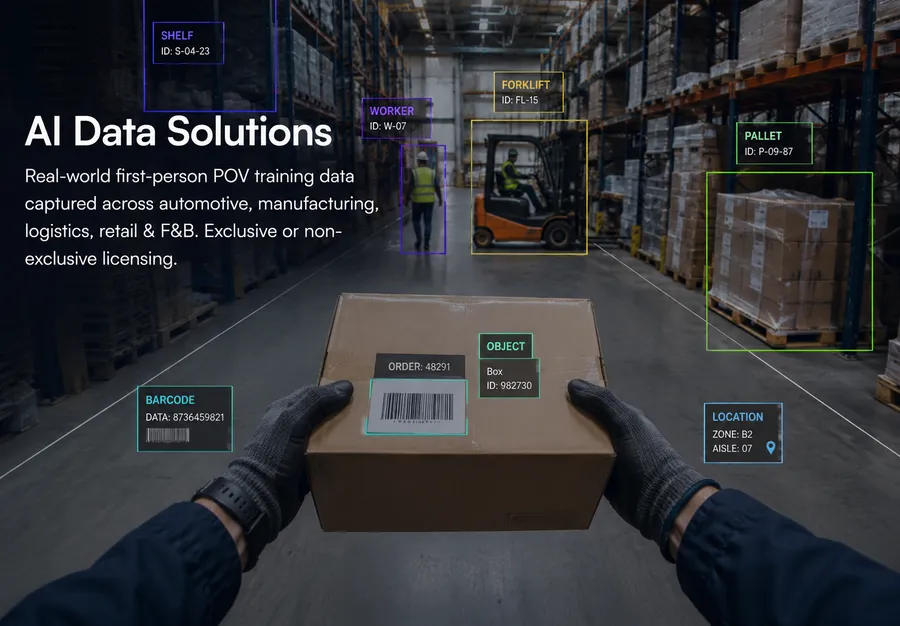
Trained people record real tasks in live environments, with documented consent and synchronized sensors. This is the part we do commercially today.
02
Learn from it
Annotated multimodal data is what lets a model understand how humans actually handle objects, spaces, and edge cases. We are studying where this moves results.
03
Act in it
Systems that perceive and act in the physical world are the reason the data matters. That is the direction, and we will publish it when there is something to show.
[ 02 ]Programs
Three programs. One of them is a product.
3 programs · 1 shipping
Available
Real-World AI Data
Consent-verified multimodal data captured by trained people in live working environments, then annotated and licensed to specification.
Evidence
21 delivery formats, 10 capture industries, 12 annotation types, 4 licensing paths — all listed on the home page with sample output.
Research into which parts of robot autonomy improve most directly from human-captured real-world data.
Open question
Which layer of robot autonomy does our data advantage unlock first — perception, world modelling, or manipulation policy?
What we are testing
Internal evaluation of our own capture and annotation output against published embodied-AI baselines, to find where real-world human data changes results and where it does not.
Exploring
Intelligent Devices
Early thinking on the hardware we would need to own in order to capture better data than we can buy off the shelf.
Open question
Would a purpose-built wearable capture rig produce materially better training data than the commercial hardware we use today?
Built so far
Nothing. This is a direction, not a product.
[ 03 ]What we publish, and when
A program moves up only when the evidence does.
Exploring
A written open question. No capability, product, or timeline may be described.
Research
The open question plus what is being tested to answer it.
Prototype
A real artifact a reader can inspect, plus an honest note on its limits.
Available
A capability that can be licensed today, with proof published on this site.
No launch dates, no renders presented as products, and no capability claimed before it exists. If a program is quiet here, it is because there is nothing honest to show yet.
[ 04 ]Open questions
The questions we have not answered yet.
01
Where does human-captured real-world data beat simulation, and where is simulation simply cheaper and good enough?
02
How much of a robot stack can be improved by better data alone, before architecture becomes the limit?
03
Which capture modality is most underserved today relative to what model teams actually ask us for?
04
What would we have to build ourselves because no vendor sells it?
Working on physical intelligence?
The fastest way to work with us today is the data. Tell us what your model needs to see and we will tell you honestly whether we can capture it.
We use cookies to analyse site performance and deliver relevant content. Some are essential; others help us improve your experience and serve targeted ads. Privacy Policy
GDPR & UK GDPR compliant. You can change your preferences at any time via our Privacy Policy.